

Hearing Services Aberdeen

t: 01224 647652

Hearing Services Aberdeen

Cochlear Implant Referral Journey

Watch and listen as Jayne and David talk about the Cochlear Implant journey from the decision making to 7 months post surgery.

Video use by kind permission of the BSHAA [British Society of Hearing Aid Audiologists]

What is a Cochlear Implant and How Does It Work?

A cochlear implant is a small electronic medical device that helps people with severe to profound hearing loss hear sounds by directly stimulating the auditory nerve. It’s different from a hearing aid: hearing aids amplify sound, but cochlear implants bypass the damaged parts of the inner ear altogether.

A cochlear implant has two main parts:

1. External Component
  • Microphone – picks up sound from the environment

  • Speech processor – converts sound into digital signals

  • Transmitter (coil) – sends the signals through the skin to the internal implant

2. Internal Component (surgically implanted)
  • Receiver–stimulator – receives signals from the transmitter

  • Electrode array – a set of tiny electrodes inserted into the cochlea (inner ear)

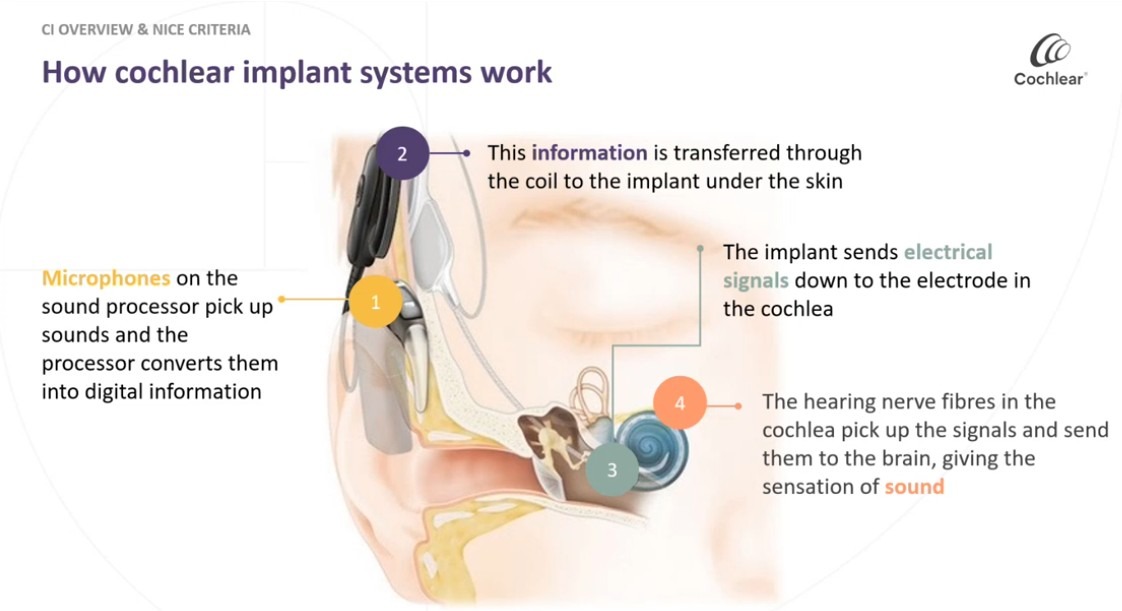
How the cochlear Implant works
Step-by-step
  1. Sound enters the microphone on the external piece.

  2. The speech processor turns the sound into digital information.

  3. The transmitter coil sends this information through the skin to the internal receiver.

  4. The receiver sends electrical signals to the electrode array inside the cochlea.

  5. Electrodes stimulate the auditory nerve fibers, replacing the function of damaged hair cells.

  6. The auditory nerve sends the signal to the brain, where it’s interpreted as sound.

Want to know more? Please get in touch – we’d love to hear from you!

© Copyright Bryce Hearing Services 2013-18 | Privacy Policy  | All rights reserved | 49 Rose Street, Aberdeen, AB10 1UB Reg No: 1234567890

x  Powerful Protection for WordPress, from Shield Security
This Site Is Protected By
Shield Security

By continuing to use the site, you agree to the use of cookies. more information

The cookie settings on this website are set to "allow cookies" to give you the best browsing experience possible. If you continue to use this website without changing your cookie settings or you click "Accept" below then you are consenting to this.

Close